
Over the past twelve months, 109,203 real co-op customers have shared their feedback through NCG’s Customer Experience (CX) Program. Their message is clear: product availability is the single strongest driver of loyalty at food co-ops.
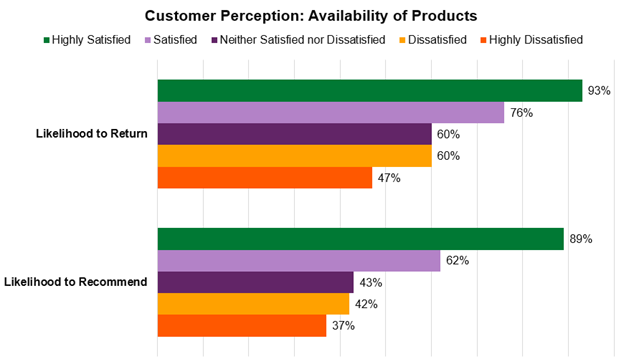
Yet today, only 58% of co-op customers report being highly satisfied (5 out of 5, green bars) with product availability, about 10 points behind the typical premium grocer. The loyalty difference is striking: 93% of those highly satisfied customers say they are highly likely to return to the co-op, and 89% say they are highly likely to recommend the co-op to others.
Among customers who report being merely “satisfied” (4 out of 5, purple bars), those numbers drop sharply: 17 points lower for likelihood to return and a striking 27 points lower for likelihood to recommend. As we move further down the chart, the picture only gets worse. When customers can’t reliably find what they need, they shop elsewhere — often, outside of the cooperative economy. Anything less than a highly satisfying experience with product availability represents a monumental missed opportunity in co-op customer loyalty and in real sales dollars.
When co-op leaders see the 58% satisfaction score, a common question arises:
What does product availability actually mean to customers? Are they asking for products we simply don’t carry? Or are items that should be on the shelf missing when customers go looking for them? Data suggests that the answer is overwhelmingly the latter. When we examine customer comments and accompanying survey responses, the vast majority of respondents cite concerns related to products the co-op typically carries but could not be found on the shelf.
In other words, the issue is typically out-of-stocks, not assortment.
The full-shelf mentality
We spoke with two co-op leaders whose teams consistently outperform the average co-op on product availability by a wide margin: Patty Smith, General Manager at Willimantic Food Co-op in Willimantic, Conn. and Gina Molby, Store Team Lead at New Pioneer Co-op’s Cedar Rapids, Iowa location.
Their secret? Nothing flashy. Just disciplined, back-to-the-basics, retail excellence. Small habits, repeated consistently, every day. You might say that their co-ops have adopted a full shelf mentality. We’ve consolidated some of the practices their co-ops and other top-performing co-ops have committed to, along with some of NCG’s best practices. If your co-op hasn’t already integrated these practices to achieve a full shelf mentality, the time to start is now:
Physically count the holes, ideally every day
It doesn’t have to be complicated — put your best critical customer hat on, walk the aisles with a pen and paper, and make tally marks for how many holes per department or per aisle. Track closely. The goal next week is to have fewer holes. Your co-op might choose to add technology to the mix and scan holes for tracking purposes. That’s a welcome addition, but don’t let the perfect get in the way of achieving the good. NCG has a plug-and-play out-of-stock tracking worksheet available here to help kickstart your practice.
Large retailers like Kroger and Wegman’s count out-of-stocks from the customers’ perspective every single day and often set a threshold of no more than 2-3% of their stores’ item assortment out of stock at any given time. These are massive stores that take a lot of time to count.
If a daily count feels ambitious, we challenge you to commit to it anyway — you’ll learn a lot by spending the additional time focused on what your customers see in the aisles — and you won’t be disappointed by the impact. If you need to start smaller, begin with a consistent one to three times per week, and build your way up to a consistent daily practice.
Use clear out-of-stock signage, but don’t let it linger
When an item truly isn’t available, follow NCG’s best practices for out-of-stock service recovery. These best practices suggest leaving out-of-stock signs up for no more than two weeks before expanding neighboring products into the hole. Some top-performing co-ops take an even more proactive approach, empowering staff to act quickly to avoid holes at all costs.
At New Pioneer Co-op’s Cedar Rapids store, staff are expected to flip shelf tags and face over a hole on the shelf if the product won’t be filled within about 24 hours. Importantly, staff are trained and empowered to be proactive, and the co-op has strong systems in place for keeping track of those flipped tags and ensuring items are reordered appropriately.
Here’s the mindset: not every customer is going to come in for that particular out-of-stock cereal. However every single customer is going to walk past the empty hole on the shelf and feel that scarcity. A hole on the shelf is never “just a hole” — it’s a problem someone is responsible for solving.
Obsess over your most important items
As general manager at the Willimantic Food Co-op, Patty always knows the shelf status of key items. When we say always, we mean every single day — when Patty’s in the store, she’s keeping an eye on top-selling items and checking in with her team if the condition of these items is anything less than ideal. Co-op leaders of all levels should be able to recite the most important items in their departments and stores from memory and be keenly aware of the status of those items at any given moment — to the point where you’re annoyingly on top of it. Consider starting with a list of your top 25 sellers, then over time, expand to your top 50 or even top 100 sellers.
Service and product availability are deeply connected. Service begins with warm, proactive greetings
Product availability is about more than what’s on the shelf — it’s about helping customers find what they need. A simple hello opens the door for customers to feel comfortable asking for help, and for staff to connect customers with alternatives.
A customer looking for a highly recognizable Cheerios box to no avail might not realize that the co-op carries Field Day O’s just a few feet away.
Ensure that your team recognizes the deep connection between strong service and product availability perceptions. Frequent reminders are necessary.
Monitor distributor and vendor out-of-stocks and act accordingly
It’s tempting to blame our out-of-stocks on distributors and local vendors — and occasionally, some blame is justified — but it’s critical that we do everything in our power to never let customers feel the pain. Pay close attention to distributor and vendor out-of-stocks — especially the UNFI “Supplier Out of Stocks” report and UNFI invoices for any items that are listed as long-term OOSs. Then make a plan to deal with those out-of-stocks. Ultimately, you are in control of what your shelves look like, regardless of distributor or vendor performance.
Transparent communication cultivates community
At the Willimantic Food Co-op, walkie-talkies are part of the magic. At checkout, customers are asked, ‘Did you find everything you needed today?”We’d be remiss not to mention that Willimantic has the strongest checkout experience satisfaction in the country. Often, the answer is “Actually, I was looking for such and such…”and the cashier immediately walkie-talkies the back room to ask about the product. The customer hears the question and the answer, loud and clear. That’s transparency.
Fronting and facing never goes out of style
If a product isn’t pulled to the front on the bottom two shelves or the top two shelves, for many customers with limited mobility, shorter or taller stature, or even simply just in a rush, the item might as well be out-of-stock. At top-performing co-ops, all staff are actively engaged in improving shelf conditions, all the time. As a former co-op marketing director, my screen-time breaks were typically taking 15 minutes in the aisles, straightening up top-selling items and those pesky top and bottom shelves. If there are staff at your co-op who think fronting and facing the shelves isn’t part of their jobs, it’s time for a refresher training.
Product availability builds trust
Customer feedback tells a clear story: when customers are delighted with product availability, loyalty skyrockets. Customers come back more often, and they enthusiastically recommend the co-op to friends and neighbors. Improving product availability isn’t just about filling shelves; it’s about strengthening the relationship between the co-op and the community it serves. Abundant shelves reinforce the message: this is a store you can count on.
For support in integrating any of the best practices above at your co-op, please contact your co-op’s NCG Strategic Development Manager.